

In a bit of irony, the cars of ‘Thank God It’s Friday’ suffer their own disco demolition night
There is a bit of the “So bad, it’s good” going on with “Thank God It’s Friday.” Yes, it’s a bad movie. It’s not funny. Siskel & Ebert each gave it 1½ stars.
They are not wrong.
But the critics of the time miss something that matters: “Thank God” is a happy movie. It will sort of feel R-rated, but it’s rated PG. There aren’t any drug problems. Nor racist baggage. Nor stereotypes. No Vietnam or Watergate trauma. It’s good clean fun.
There are things aspiring filmmakers can learn from the stinkers. Quick cuts. Groovin’ disco soundtrack. Short run time. Colorful. A cast that reflects Hollywood’s estimations of these young people around age 20. Put all of those together, you’ve got something. The worse and worse it gets, “Thank God” somehow keeps you wondering if something interesting might be just about to happen.
It’s even an Oscar winner.
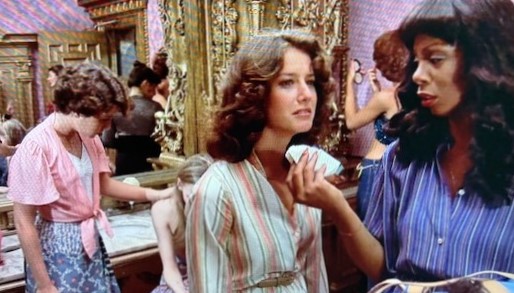
Debra Winger and Donna Summer portray not having fun
while Valerie Landsburg perhaps consoles Terri Nunn telling
her she’ll be singing “Take My Breath Away” next decade.
Discotheques can be exciting places. But one of the strange decisions of “Thank God” is to confine nearly the entire movie, not all of it but nearly all of it, to this place called the “Zoo,” so named even though only one early character, quickly forgotten, wears an animal costume and is scolded for taking off his mask. (“I pay you to look like a monkey and run the elevator — not one or the other.”)
The building used as the Zoo was at 333 S. La Cienega Boulevard, which apparently is Beverly Hills and today is the site of an AMPAS library. There’s an obsession in the film with stairways. There’s viewer claustrophobia as characters constantly hang over each other and bump into each other, sometimes rather forcefully. Now, in real life, is that an accurate portrayal of a night at a disco? Actually yes. This is an instance where artistic license grants the freedom to give these characters a little breathing room.
There’s also the recurring issue of getting locked inside of doors, or outside of doors. (Where’s the fire marshal.) And then there are all the car smashups that seem to defy the laws of physics, all for the point of providing a slapstick parking lot gag at the end. The line to get in isn’t nearly as long as a club operator would hope (you can just walk up and enter), the fellow taking the cover charge and stamping backs of hands wears a suit and tie and is supposed to create problems for a few of the hapless guests, but little drama happens in that meager line. It’s a discotheque that sells jewelry and has about two bouncers on hand for security.
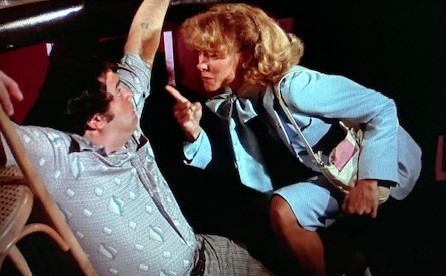
One of the most obnoxious film characters of the ’70s
gets his comeuppance from a teacher.
Attempting to illustrate what the film wants everyone to believe, that Disco Fever is sweeping the country, the words “Thank God It’s Friday” are shown on an L.A. Freeway sign, boutique store signs, digital gas station signs, movie marquees and even the Goodyear Blimp. (Maybe a couple of those aren’t the actual lettering.)
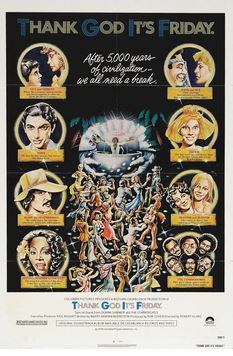
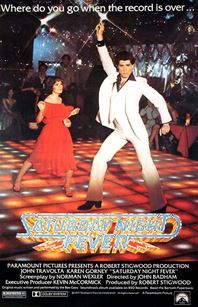
Roger Ebert says the advertising for “Thank God” was considerable and even “honest” in selling the film as “American Graffiti” meets “Saturday Night Fever.” Those latter two though are dramas. He doesn’t note that the same thing happened with “Star Wars,” everyone was suddenly demanding a space movie, “Battlestar Galactica,” “The Black Hole,” even “Moonraker.”
“Thank God” has as much in common with “The Love Boat” as it does landmark teen movies. There are at least six pairings of people (that may not necessarily be the correct number), each having their own personal dramas, as well as a handful of individuals needed to spice things up for the people in those pairings, all in the same locale. A little more ambitious, and the film would’ve had a couple of the main characters trying but failing to get in to the Zoo and having to spend the night at diners and other places and running into various freaks, only to have their own life-changing moments and ultimately cross paths with the clubgoers in the parking lot as ending credits roll.
At least “The Love Boat” develops story threads. If only they’d done that here. “Thank God It’s Friday” surrenders early, relying instead on one sketch bit after another which may or may not have much connection to the character’s previous sketch bit. On the plus side, the sketches skip along. When they quickly dry up, itrsquo;s on to another.
The worst character has to be the garbageman who at first hints at being an Ernest Borgnine-like character. Instead he’s a thug who’s mad because he can’t find his “computer” date (how many people were doing computer dating in 1978), and then when he does, she’s too tall. At first, in a bit of unintentional success, we’re led to believe the date, “Shirley,” might be the woman sitting alone and who may have decided, upon first glance at seeing this individual approach, that she’s not going to follow through on the date and will deny being a part of it; presumably, that would open the door to drama, his better side emerges, she regrets lying and they get together. But no. She really is not his date and wisely makes sure it doesn’t end up that way. The unfortunate woman who is his date somehow tries to encourage him to “make the best of it.”
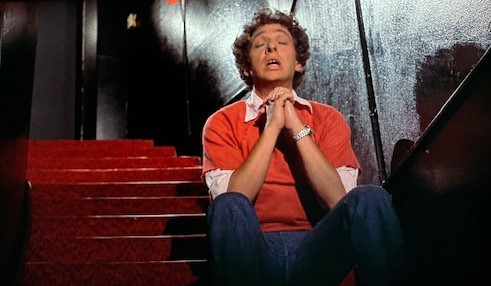
Paul Jabara trapped in a stairway. His contribution
brought this film an Oscar (but not for acting).
Comedy films often stick it to the squares, in particular, the uptight guy who doesn’t appreciate his beautiful wife who just wants them to relax and have a little fun. So the script calls on Jeff Goldblum’s sleazy Tony to hit on Andrea Howard’s Sue, which will eventually bring out the best in her husband, Dave, played by Mark Lonow. Tony’s intrusion would be really creepy, so Sue has to provide clearance by reducing her dress and telling Dave: “This is the way the designer intended the dress to be worn.” Nothing Tony tells her is funny. And she never really falls for it anyway.
No matter how bad they might be, movies such as “Thank God It’s Friday” that feature teenage or early 20s actors are going to be a source of fascination for how, through casting, they appeared to “rank” the talent of their young stars. The filmmakers are hoping to hand the lead roles to the names that will appear in the digital descriptions on your TV 50 years later. In 1978, Jeff Goldblum, who is quite good here as a sleazy smooth talker, was already on his way; Debra Winger, in her second role, proved the movie’s biggest discovery. (It’s amusing how late her name appears in the opening credits.)
If there was an expectation by the “Thank God” filmmakers of a breakout star, it would likely have been Valerie Landsburg, whose Frannie is the first character featured in the opening montage and who also gets the “glamour” moments as the champ of the night’s purported drama, the dance contest. Landsburg’s, like half the characters in the ensemble including Winger’s, is the serious worrywart who is convinced that everything is going wrong. She has something of the Molly Ringwald look about five years before Molly Ringwald. She is apparently most well-known for the TV series of “Fame.”
The adventures of Frannie and her high school friend Jeannie desperate to get into this nightclub bring to mind what was a curious issue in the late 1970s: drinking age. In some states, it was 21. According to the Federal Trade Commission, “After Prohibition, nearly all states adopted a minimum legal drinking age (MLDA) of 21. Between 1970 and 1975, however, 29 states lowered the MLDA to 18, 19, or 20, largely in response to the change in the voting age. Studies conducted at the time showed that youth traffic crashes increased as states lowered their MLDA. In addition, the ‘blood borders’ between states with different MLDAs caught public attention after highly-publicized crashes in which youth below the legal drinking age would drive to an adjoining state with a lower MLDA, drink legally, and crash on their way home.”
Donna Summer (apparently regarded by Vincent Canby as an inferior version of Diana Ross) and The Commodores were the superstars who provided “Thank God” with box office heft. Yet, incredibly, it’s one of the film’s teenagers, Terri Nunn, who would ultimately sing a song that’s probably more famous than Summer’s “Last Dance,” not in this movie but in a much bigger hit nearly a decade later: “Top Gun.”
“Thank God” offers some sort of proof that disco songs maybe aren’t meant for comedies. Maybe they could be, if used in the right spots. “Caddyshack” hilariously makes hay out of a couple of pop hits, “Boogie Wonderland” and “Any Way You Want It.” But the endless sketches of “Thank God,” feel like an intrusion on the soundtrack.
The soundtrack is good but not great. It can’t help but be compared with the all-world “Saturday Night Fever,” a level no film will match, but too much of “Thank God” sounds like run-of-the-mill disco-era material, including the title track. The biggest disappointment is that The Commodores perform one song and it’s not one of their biggest: “Too Hot ta Trot.”
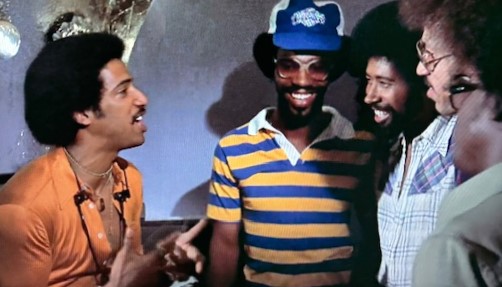
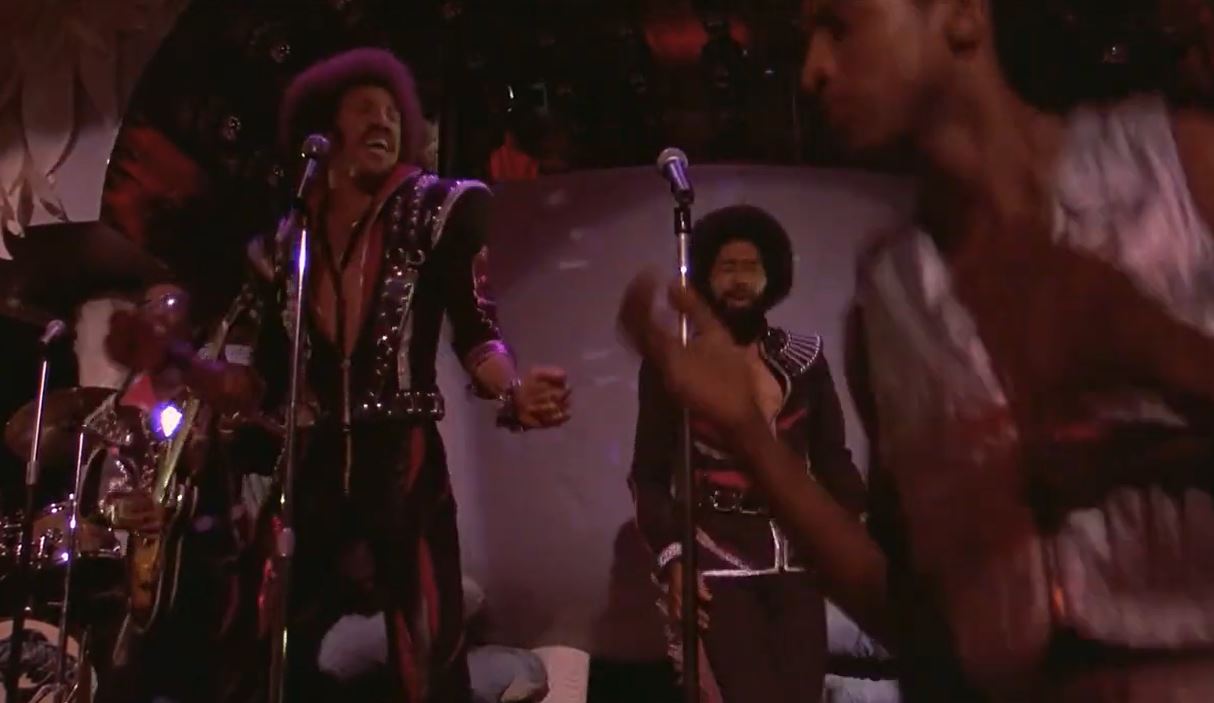
The camera barely catches Lionel Richie.
At least the movie was just in time to get Lionel Richie, a couple years before he would leave The Commodores for solo megastardom. In a nice touch, the film shows The Commodores arriving in street clothes, likely the way they looked in real life when not in performance gear. Richie and the other members are not featured individually here; the filmmakers preferring the deejay drama of Ray Vitte’s Bobby Speed (who often talks to himself, but so do other characters) and, more inexplicably, a road trip quagmire not including band members but their purported equipment man, “Wrong Way Floyd,” played by DeWayne Jessie. His first police stop is eye-rolling enough, it’s painful that they decided to re-create it near the end. Jessie would have much bigger success in another film that year, “Animal House.”
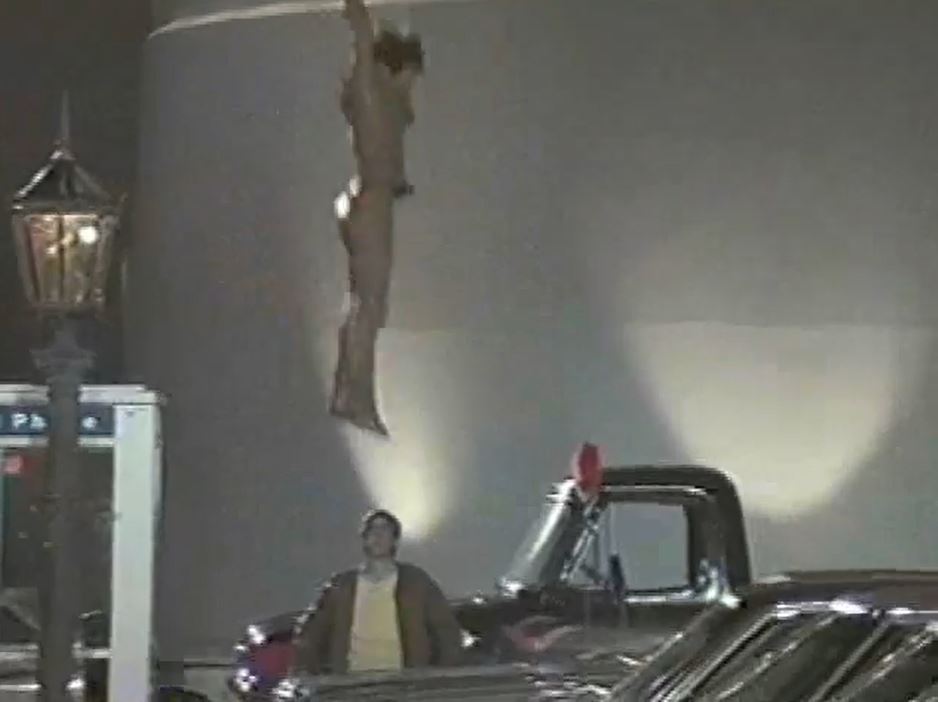
The plot hook is supposedly a dance contest, but there is very little dancing in “Thank God.” Yet its signature scene is indeed a dance, as Chick Vennera performs on car hoods in the parking lot. He even honks a horn with his foot. This routine is actually more impressive than John Travolta’s solo in “Saturday Night Fever,” though Vennera is actually a pro dancer. There are a couple references to nice cars that the movie doesn’t really care about; it’s more interested in its repeated smash-up mayhem by drivers who are half-blind.
Brian Wilson spoke about concerns about “God” being in the title of “God Only Knows.” By 1978, that word evidently prompted no outcry in a film as frivolous as this. But choice of title here is a head-scratcher. Presumably, it’s a play on “Saturday Night Fever” and implies we should be having fun on Friday nights. But it doesn’t imply anything about Donna Summer or The Commodores or teenagers. Or music in general. Vincent Canby complains that the movie is “really a record album with live-action liner notes.” (Pauline Kael apparently never commented on it.)
The rating is significant. “Thank God It’s Friday” is rated PG. “Saturday Night Fever” was correctly rated R, but as teenagers and producers correctly lamented that teens couldn’t go, a PG-version was released. “Thank God” should be a coming-of-age story, as is “Saturday Night Fever.” It avoids the kinds of grit that earned “Fever” an R but costs itself a core audience by often ignoring the teens in favor of the 20something nightclub crowd lamenting they can’t have fun anymore. For that audience, the movie is tame. There’s no nudity and the language is light. During a phone conversation, you will hear a word in this movie that you probably would not hear had the movie been done just a years later, or any time after that. It is not used as a slur, but today is startling.
“Oscar nominee” for this film sounds preposterous. Yet it happened. And not only was it a nomination, but a win. By one of its actors.
The winner is Paul Jabara, who not only plays the visually and beer-challenged Carl but is actually the composer of “Last Dance,” the Donna Summer song that is to be the movie’s signature moment. It’s not that unusual for a good song from a mediocre film to win an Oscar. It’s definitely unusual for the Academy to choose a film such as “Thank God It’s Friday,” especially considering what it beat out: John Farrar’s “Hopelessly Devoted To You,” sung by Olivia Newton-John in “Grease.”
If you like films that look like the late ’70s (and many of us do), you can at least get a jolt of nostalgia from “Thank God It’s Friday.” No cellphones. Even a telephone booth that comes in handy a couple of times. It’s also vintage L.A. In summer 1978, “Thank” was maybe passable for a night at the drive-in. Aside from Vennera’s soaring solo, the most inspired work in this picture is the Columbia Torch Lady’s disco moves. She deserves better.
2 stars
(October 2026)
“Thank God It’s Friday” (1978)
Cast:
Valerie Landsburg as
Frannie ♦
Terri Nunn as
Jeannie ♦
Chick Vennera as
Marv Gomez ♦
Donna Summer as
Nicole Sims ♦
Ray Vitte as
Bobby Speed ♦
Mark Lonow as
Dave ♦
Andrea Howard as
Sue ♦
Jeff Goldblum as
Tony ♦
Robin Menken as
Maddy ♦
Debra Winger as
Jennifer ♦
John Friedrich as
Ken ♦
Paul Jabara as
Carl ♦
Marya Small as
Jackie ♦
Chuck Sacci as
Gus ♦
Hilary Beane as
Shirley ♦
DeWayne Jessie as
Floyd ♦
The Commodores as
The Commodores ♦
Phil Adams as
Tarzan ♦
Judith Brown as
Badmouth in Bar ♦
Marianne Bunch as
Boutique Salesgirl ♦
Tony Cacciotti as
Club Cashier ♦
Jacqueline Carlin as
Blonde in Blue Blouse ♦
Linda Creamans as
Tony’s Friend #1 ♦
Gregory V. Karliss as
Second Bar Boor ♦
Wade Collings as
Jennifer’s Partner ♦
Cosie Costa as
Parking Attendant ♦
Chris DeLisle as
Tony’s Girlfriend ♦
MacIntyre Dixon as
Bartender ♦
Michael Durrell as
Bar Boor ♦
Al Fann as
Sam (voice) ♦
Harry Gold as
Mercedes Driver ♦
Heidi Gold as
Blonde with Carl ♦
Nanci Hammond as
Marv’s Dancing Partner ♦
Steven Hartley as
Swinger in Phone Booth ♦
Howard Itzkowitz as
Transvestite ♦
Osko Karaghossian as
Bouncer ♦
Solomon Karriem as
Another Bouncer ♦
Sheila MacKenzie as
Tony’s Friend #3 ♦
J.W. Bear Martin as
Bouncer at Bobby’s Booth ♦
Shelly Parsons as
Tony’s Other Girlfriend ♦
Sherry Peterson as
Tony’s Friend #2 ♦
Nicholas Shields as
Gorilla in Elevator ♦
Vaya Warren as
Guy Who Cuts in on Jennifer ♦
Richard Weinberg as
Bar Boy in Blue ♦
Sandra Will as
Miss Negative ♦
Jonathan Wynne as
Trooper
Directed by: Robert Klane
Written by: Barry Armyan Bernstein
Producer: Rob Cohen
Associate producer: Tony Masters
Associate producer: Lauren Shuler
Executive producer: Neil Bogart
Co-producer: Phillip Goldfarb
Cinematography: James Crabe
Editing: Richard Halsey
Casting: Mike Fenton, Jane Feinberg
Production design: Tom H. John
Set decoration: Jeff Haley
Costumes: Betsy Jones
Makeup and hair: Stephen Gautier, Shawn McKay, (Miss Summer’s Hair Styling By) Louie Harris
Unit production manager: Phillip Goldfarb
Stunts: Bill Couch, Bud Davis, Gary Davis, Don Pulford, Rock A. Walker, Ernie Robinson, Bob Masino, Terry Nichols, Benji Bancroft, Benny Moore, Dick Ziker