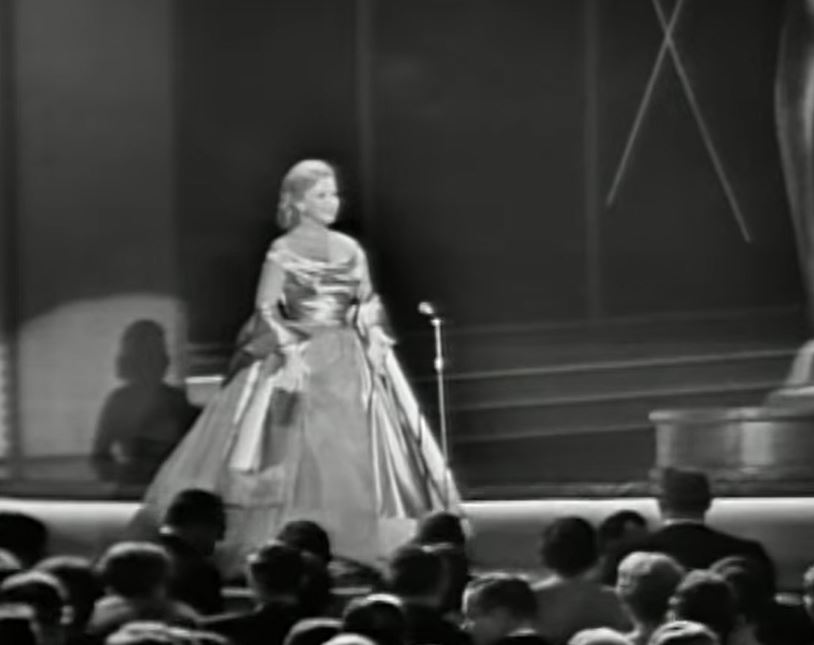
The one & only — Mary Costa’s
magnificent rendition of
‘The Star-Spangled Banner’
at the 1962 Academy Awards
Posted: May 2026
It’s not something you see every year.
In fact, if you weren’t watching in 1962, you’ve never seen it at all:
A singer performing “The Star-Spangled Banner” at the Academy Awards.
The ascent of “The Star-Spangled Banner” to national anthem (the term is generally lower case, according to the Associated Press Stylebook) was not smooth. It took more than a century, officially signed into law by President Herbert Hoover in 1931. Composed as a poem by Francis Scott Key in 1814 and set to music of a popular British song, there were differing versions and, in the third stanza, which today is unobserved in performances, controversial lyrics.
Still, “The Star-Spangled Banner,” as well as a handful of other patriotic songs, was being played at civic events by the late 1800s. President Woodrow Wilson pushed Congress to certify it the national anthem. The 1918 World Series between the Chicago Cubs and Boston Red Sox is believed to be a signature moment. Because of World War I, the season ended early and baseball had attendance problems. The Chicago World Series games were played at Comiskey Park, which had greater seating than the Cubs’ Weeghman Park (now Wrigley Field). In Game 1, as Babe Ruth was pitching the Red Sox past the Cubs, a Navy band belted out “The Star-Spangled Banner” in the 7th inning. Army planes flew overhead. Ring W. Lardner noted in the Chicago Tribune that players were “standing at attention,” and another Tribune article that day, by James Crusinberry, referred to the song played as the “national anthem.”
Today, and apparently since World War II, “The Star-Spangled Banner” is a fixture at ballgames, typically pro sports events but also those of college and high school. In certain instances, there has been objection to the perceived demeanor of either the performer of the anthem or the performers at the event at which the anthem is played.
But the anthem has not been played at every game, for various reasons, and there seems to be no objection to that.
Which brings us to the Academy Awards.
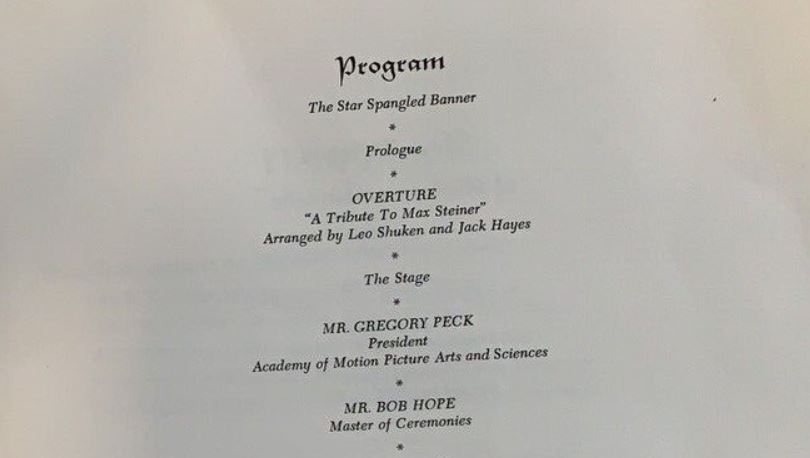
The program for the 1968 Oscars begins with “The Star-Spangled Banner”
“The Star-Spangled Banner” was performed at the Oscars in the early 1940s. In the 1950s and ’60s, it topped the Oscars program, without a hyphen in the title. How it may have been performed is a subject of mystery.
According to the book Inside Oscar, by Mason Wiley and Damien Bona, the first performance of “The Star-Spangled Banner” at the Oscars appears to have occurred in 1942, when the show was not televised but was a radio hit. The awards then followed a dinner. At the start of the program, “Jeanette MacDonald launched into the national anthem” and even sang the second verse; the event was so crowded with military personnel and others that many guests had difficulty standing. A flag was unfurled by Tyrone Power and Alan Ladd listing 27,677 Hollywood names who had entered service. MacDonald, then 38, a soprano who acted in musical films, performed often for the war effort and would sing “The Star-Spangled Banner” at Eisenhower’s 1953 inauguration. MacDonald died in 1965 at 61.
The 1943 Oscars opened with Susanna Foster singing “The Star-Spangled Banner.” Foster, a starlet who was discovered at age 12 and apparently idolized MacDonald, was 18.
But perhaps the first patriotic song performed at the Oscars was three years earlier, when Judy Garland, 17, performed “My Country ’Tis of Thee” (also known as “America”) for President Roosevelt, who had delivered a radio address to begin the program.
It appears, after the war, the anthem was not necessarily featured. It would take another decade for the Oscars to air on television. But the 1940s shows were broadcast on radio. In 1948, according to Inside Oscar, “The show began with a seventy-five piece orchestra playing ‘The Star-Spangled Banner.’”
TV broadcasts of the Oscars began in 1953. Despite its placement on the official program, ahead of the “Prologue” and overture, the Oscars’ performance of “The Star-Spangled Banner” evidently took place prior to the broadcast and was not featured on television.
Until 1962.
That was when Costa, then 31 and now in her 90s, was tapped to perform for ABC’s cameras after just a few brief introductory flashes of the red carpet. Perhaps Richard Dunlap, who directed Oscars telecasts throughout the 1960s, simply thought it was time to feature the anthem.
Announced by Hank Sims as “Miss Mary Costa,” Costa, in beautiful gown, darted in from the left side of the stage, quickly began singing, and just as quickly, departed.
The orchestra continued on with the then-typical overture. Usually the overtures involved some medley of songs linked to nominated movies; sometimes they included the old favorites “That’s Entertainment!” or “Hooray for Hollywood.”
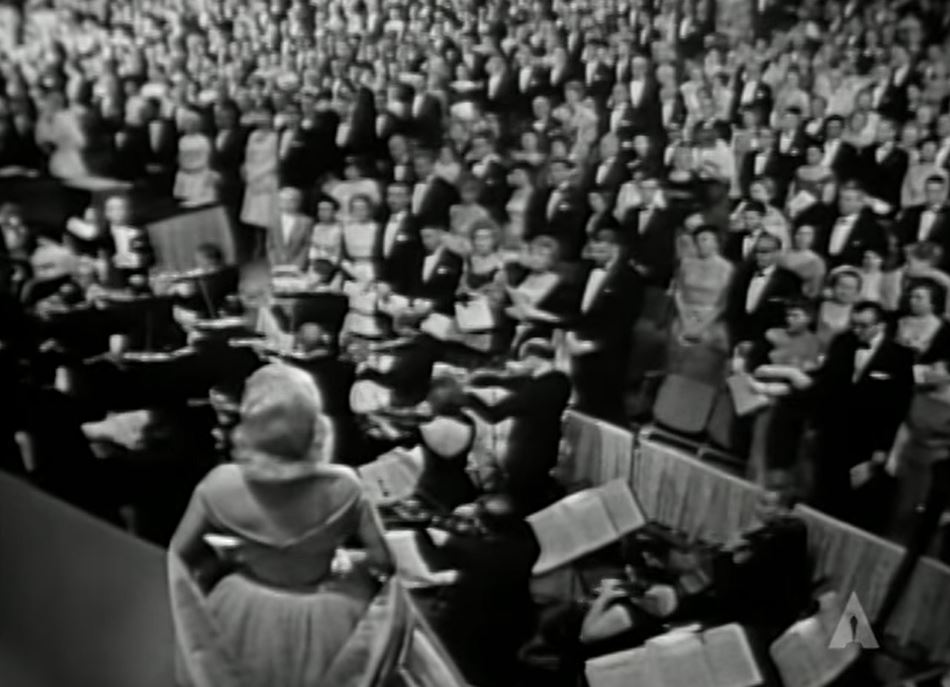
There are probably several reasons why “The Star-Spangled Banner,” despite officially kicking off Oscars programs in the 1950s and ’60s, was not shown on TV. Time constraints might be one reason; a more likely reason would be that it might’ve been performed by the orchestra while guests were still arriving and before most seats were filled. And that viewers watching the entire show would possibly be hearing the anthem as the network signed off at the end of the night.
Unlike baseball, which has steadfastly performed the anthem, Hollywood gradually had a change of heart. Even in 1968, amid Vietnam and unrest in American cities, the anthem was atop the Oscars program. Suddenly, by 1970, it was no longer there. And evidently hasn’t returned.
Anyone with a passing interest in Hollywood is aware of the Blacklist and HUAC and Red Scare and Sen. Joseph McCarthy and the impact on the film industry. Hollywood of the ’50s and ’60s was also filled with veterans. Approach to the anthem from Hollywood is undeniably complicated. “The Star-Spangled Banner” may have been dropped in protest of American foreign policy. Or it may have been dropped because some may have questioned whether the anthem was a necessary component of an awards presentation.
Which is what makes Costa’s unique performance one for the ages. A singular echo of the time when Hollywood, like every corner of America, sent its sons to the front lines of the fight for freedom and was galvanized by a rallying cry. Nowadays, few in Hollywood, or any sector, are veterans. Over time, “The Star-Spangled Banner” has drawn attention from those questioning America’s “direction” as well as those favoring it. Some may doubt that the anthem will ever again be performed at the Academy Awards. Don’t count it out.