Omar N. Bradley —
America’s last 5-star general
It had happened before. The newspaper headlines were small.
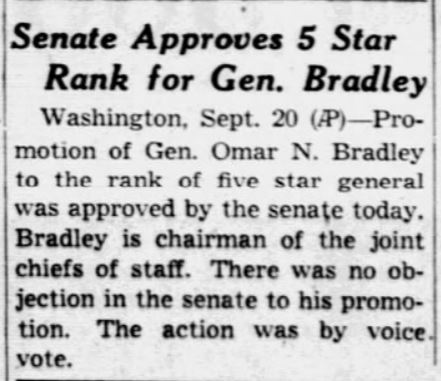
Gen. Omar N. Bradley was conferred the rank of 5-star general, and with it, the title of General of the Army, on Wednesday, Sept. 20, 1950.
It hasn’t happened since.
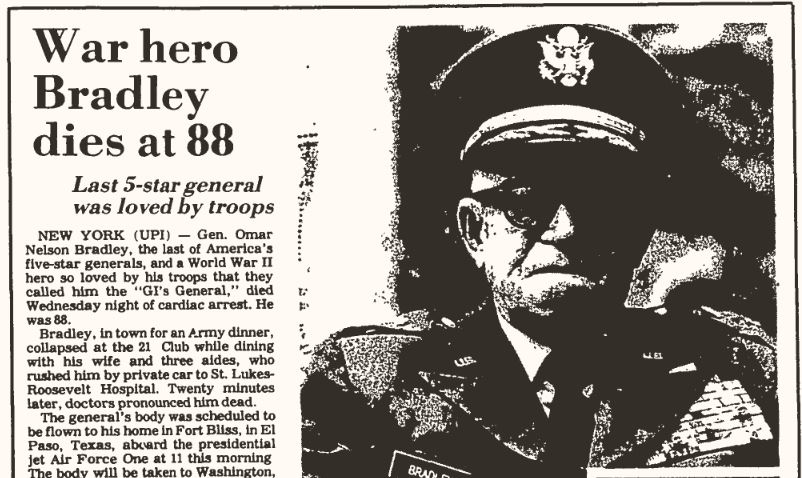
Gen. Bradley, age 88, died on April 8, 1981, in New York City. The New York Times obituary says he collapsed at New York’s 21 Club while attending a dinner of the “local chapter of the Association of the United States Army.” He was taken to St. Luke’s-Roosevelt Hospital at 7:15 p.m. and pronounced dead at 7:35 p.m.
The United Press International obituary says Bradley, who lived in Texas then and used a wheelchair, was “in town for an Army dinner.” But the U.S. Army Center of Military History says he died “just a few minutes after receiving an award from the National Institute of Social Sciences,” a reference that is on Bradley’s Wikipedia page and in other accounts.
According to the Institute’s website, it is a “Congressionally chartered not-for-profit association of public-spirited citizens” that “has awarded Gold Honor Medals every year since 1913.” Many recipients are government and academic figures, but business leaders and entertainers and media members are also notable. Bradley is on its list of 6 honorees for 1980 along with Alexander Haig; no date for a ceremony is listed, perhaps it was in April of the following year. In 2026, nominees are announced in June and the dinner is in December.
The Association of the United States Army, according to its website, “is a nonprofit educational and professional development association serving America’s Army and supporters of a strong national defense.”
An Associated Press article of Friday, April 10, 1981, says Bradley and his wife, Kitty, were simply at 21 Club “for dinner.”
According to the Chicago Tribune’s obituary, Bradley was “an obscure lieutenant colonel in Washington at the start of World War II.” He would become field commander for American forces on D-Day and would lead the 12th United States Army Group in Europe. He met Soviet Marshal Ivan Stepanovich Konev on the banks of the Elbe River.
Bradley was the first Chairman of the Joint Chiefs of Staff, in 1951. He retired from “active service,” a term used frequently in his obituaries, in 1953. According to the New York Times obituary, “A Pentagon spokesman said the General had remained officially on active duty until his death, as do all five-star generals.” (“General” was capitalized by the Times.) After active service, Bradley served as chairman of the watch company Bulova.
His death happening in the evening, at a time well before social media, there was virtually no reaction from dignitaries in the morning papers the next day. President Ronald Reagan, still hospitalized from an attempted assassination, issued a statement carried in Thursday afternoon and Friday papers: “I join all Americans in mourning the death of General of the Army Omar N. Bradley. For 69 years, he wore the colors of an American soldier — with courage, integrity, professionalism and, above all, honor. Even as he rose in rank, humility never left his side. He was the ‘GI’s general,’ because he was, always, a GI.”
Bradley’s obituary in The Chicago Tribune says the only other Army men to hold 5 stars were Dwight D. Eisenhower, Douglas MacArthur, George C. Marshall and Henry “Hap” Arnold. Then things get complicated. The 5-star designation was initiated in 1944 in accordance with the rank of General of the Army, a rank previously bestowed post-Civil War on Generals Ulysses S. Grant, William T. Sherman and Philip Sheridan, who did not wear 5 stars.
Three others have been accorded an even higher rank: General of the Armies. Those three are George Washington, as of 1976; Ulysses S. Grant, as of 2024, and John J. Pershing, as of 1919. Pershing was the only one of the three to receive the rank while active. It is considered by some to be a 6-star rank. However, Pershing never wore more than 4 stars. In its Bradley obituary, UPI says Pershing “was named General of the Armies in 1919, but turned down the fifth star.”
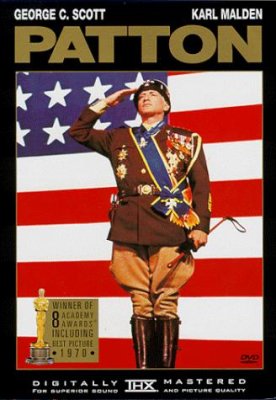
They didn’t specifically make a movie about General Omar Bradley. Yet he is a significant cinematic figure, because of the famous 1970 movie about someone he outranked: “Patton.” That film, based partly on Bradley’s book, depicts the end of the generalissimo carrying swords and the dawn of coalition warfare, when science and intercontinental weaponry would reshape battlefields, when a couple major alliances would define conflicts in Europe, Asia and many other parts of the world.
Bradley, in terms of military career, is the more successful general. Yet George S. Patton is the cinematic cause. Colorful. Dominating. Larger than life. Quotable, though profane, known for saying no “bastard” won a war for dying for his country, only for making another bastard die for his country. A tragic figure, in Hollywood’s eyes, because his superior skill that proved a driving force of the American victory was underappreciated because he failed at the niceties.
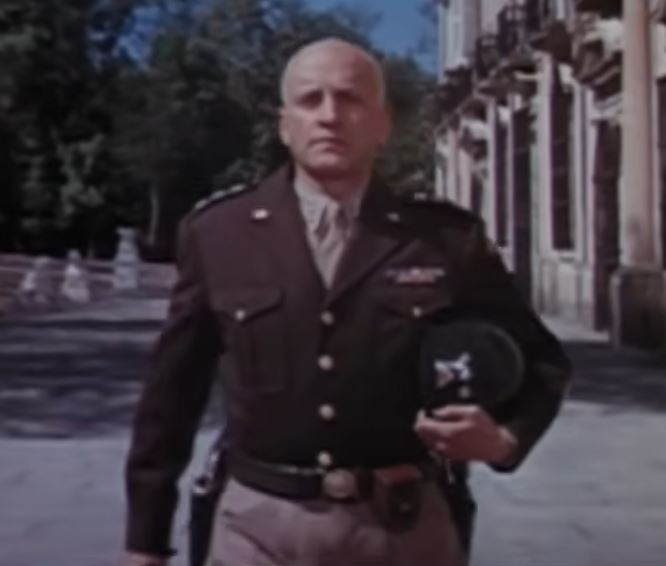
Bradley, portrayed in “Patton” by Karl Malden, is depicted as a stark opposite to Patton, a humble consensus-builder who hates war but accepts what has to be done, a champion of the GI who smoothly leads without blood-and-guts speeches. Roger Ebert in his review writes of the cinematic favor, “Even the Bradley character has no purpose other than to admonish, support and puzzle over Patton — to stand there and look at him.” The movie, providing a contrast with the Vietnam era in which it was released, was subtitled “A Salute to a Rebel.”
Quite possibly because of this movie, Patton to this day may be the most well-known World War II American general. Douglas MacArthur, who clashed with presidential authority and lost his job over it, would also be the subject of a movie titled by simply his last name, starring Gregory Peck, in 1977. “Patton” was longer, more expensive, and made much more at the box office.
The U.S. Senate on Dec. 15, 1944, confirmed the General of the Army and Fleet Admiral ranks for George C. Marshall (Army Chief of Staff), Douglas MacArthur (Supreme Commander — Southwest Pacific Area), Dwight D. Eisenhower (Supreme Commander — Europe), Henry H. Arnold (Commander of the Army Air Forces), William D. Leahy, Ernest J. King and Chester W. Nimitz. Both the Chicago Tribune and New York Times accounts of the Senate’s action list the seven names in the same order.
According to the U.S. Army Center of Military History, the ranks were conveyed in this order, days apart: Marshall, Dec. 16, 1944; MacArthur, Dec. 18, Eisenhower, Dec. 20, Arnold, Dec. 21.
The Chicago Tribune headline refers to “SUPER GENERALS AND ADMIRALS” and uses the term “super” in the story’s first paragraph. The article notes arguments from senators about the United States responding to what was perceived as Great Britain’s bestowing of elevated ranks. Sen. Richard Russell, D-Ga., complained, “if some of our allies named a man a great exalted superduper field marshal we would have a feeling of inferiority that would drive us to find some title to make officers of our armed forces equal in dignity.” Russell said the United States could call its top commander a “private fifth class” and the fact “he is leading the forces of the United States would make him equal or superior to any grade ... in the world.”
Sen. Happy Chandler, D-Ky., who would soon move on to commissioner of baseball, said he was “awfully tired” of other nominations create ranks superior to American leaders. “If the British do what they’ve always done, they’ll contrive some way to get ahead of us,” Chandler said, joking that it might require a “treaty.”
Sen. Bennett Champ Clark, D-Mo., objected to the 5-star ranks because he felt they could outrank the General of the Armies title of Pershing. Sen. J. Lister Hill, D-Ala., responded that the 5-star ranks would, according to the Tribune, that no rank would exceed Pershing’s, and that the 5-star rank would “lapse six months after the war.” According to the Army Center of Military History, that six month lapse was removed in 1946, allowing the 5-star ranks to stand permanently: “The temporary grade of ‘General of the Army’ (five-star) was provided for by Public Law 482, 78th Congress, approved December 14, 1944, and became permanent on March 23, 1946, under provisions of Public Law 333, 79th Congress.”
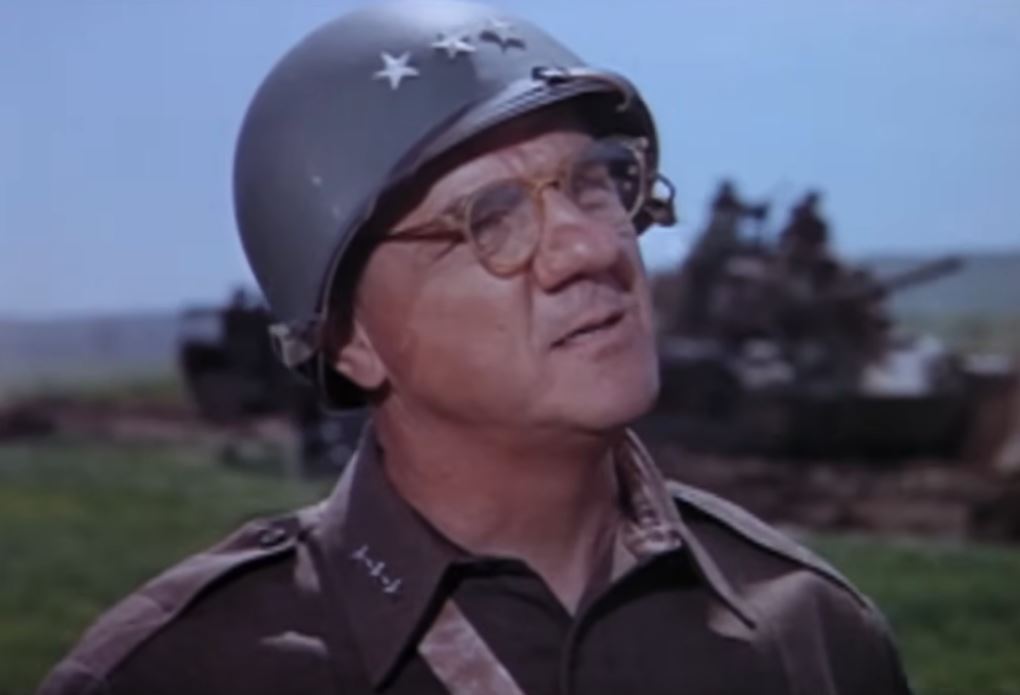
Karl Malden as Gen. Omar N. Bradley in “Patton.”
Bradley’s honor would come years later, for a different purpose. After World War II, Eisenhower had succeeded Marshall as Army Chief of Staff, at the time, probably the most powerful military post in the world and a higher distinction than General of the Army. Weighing presidential possibilities, Eisenhower took the post of president of Columbia University in 1948 and was succeeded as Army Chief of Staff by Bradley. Arnold, who had several heart attacks in the mid-1940s, retired in 1946. Marshall took the post of Secretary of State. But MacArthur remained active as commander in the Pacific. As the U.S. military was demobilizing from World War II battlefields and reconfiguring itself for the postwar era, the line of command was reshaped with the creation of the Chairman of the Joint Chiefs of Staff.
Bradley would be the first, in 1949. MacArthur still outranked him. Bradley was elevated to General of the Army on Sept. 20, 1950. It was a tiny headline on Page 10 of the Chicago Tribune and occurred the same day the Senate confirmed Marshall, still active, as Secretary of Defense, a story that got more prominent play, as there was debate over allowing a military member rather than a civilian to serve as Secretary of Defense.
A few months before his death, Bradley was able to attend the inauguration of President Ronald Reagan. The New York Times coverage of Bradley’s funeral states, “This city of deskbound generals did not turn out in throngs for the procession of the casket,” though there was a “heavy mix of military uniforms to be seen among the onlookers.”
The Bradley Fighting Vehicle, which resembles a tank, was named for General Bradley after his death. It is still in use.
The term “Greatest Generation,” popularized by Tom Brokaw in the 1990s, to many suggests the 18-year-olds drafted after the attack on Pearl Harbor, some of whom are with us today. But the term doesn’t account for much of the World War II leadership. When Pearl Harbor was bombed, Douglas MacArthur was 61, George Marshall was 60, George Patton was 56, Dwight Eisenhower was 51. Franklin Roosevelt was 59, Harry Truman was 57.
Terms that human beings call themselves are meant to convey relationships, job descriptions, activities. Sister. Neighbor. Lawyer. Plumber. Jogger. In military, titles are all-important definitions of rank, certifying who is to be in charge. In his 40s and 50s, history called Omar Bradley, and many others; he would come face to face with the Nazis, solemnly ordering tens of thousands into battle knowing many wouldn’t be coming home, delivering a victory of enormous magnitude. That can’t be summarized as “private fifth class.” General of the Army was the decision. We’re unlikely to see it again.
(July 2026)