
It’s hard to get an accurate diagnosis in this town, but ‘I Swear’ has outbursts of brilliance
One of the curiosities about Tourette Syndrome is whether the outbursts represent unvarnished truth. At times in “I Swear,” particularly when remarking on a woman’s health, there is no doubt that John Davidson is bluntly addressing reality in a way no one wants to mention aloud.
Another time, during a card game, he will correctly announce, “I’ve got two aces!”
What does it mean, then, when he also calls people the “c” word, or the “f” word, or suggests they — or John himself — might be a practitioner of very dubious activities?
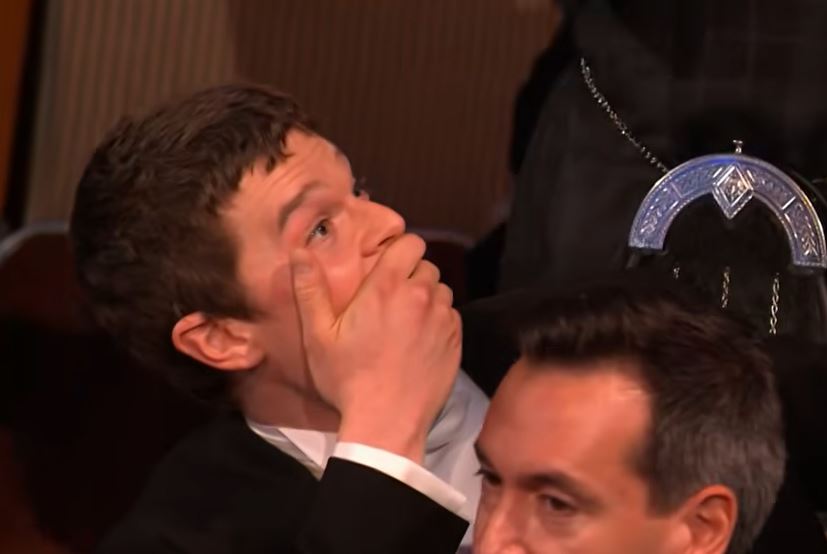
While there are many awkward moments in “I Swear,” none exceeds what happened in real life at the 2026 BAFTA Awards. “I Swear” received five nominations and Davidson, a Scottish gent not to be confused with the American singer and TV host John Davidson, attended the ceremony ... but was seated near a microphone and heard uttering a racial slur while Michael B. Jordan and Delroy Lindo were presenting an award. Apparently, it wasn’t the only slur during the half-hour Davidson was at the event. Jamie Foxx would post that “he meant that s---.” The controversy spread to the caliber of host Alan Cumming’s apology and, most significantly, the fact the BBC did not edit out the comments when the show was broadcast in Britain a couple hours later on tape delay. Apparently, editors who thought they had fixed the problem didn’t know there was more than one.
“I Swear” does not include racial or ethnic slurs, though at least one non-white character mentions that Davidson has uttered them. The most offensive terminology relates to women and sounds a bit like what was coming out of Regan in “The Exorcist.” For that reason, the movie is rightly rated R, questionable reach for a feel-good story. That rating perhaps emboldens director/writer/producer Kirk Jones to order up a crime film-level of violence, from fistfights to movie theater fracases.
Mick LaSalle writes that Davidson suffers from coprolalia, the term for involuntary outbursts of profanity or taboo subjects. LaSalle acknowledges that it may come across like Davidson is expressing his opinion but decides, “The truth seems to be practically the reverse, that the illness is causing him to blurt out whatever might be the worst, most self-destructive thing he could say in any situation.”
Viewers of “I Swear” will not believe that John Davidson is intentionally saying these things. Real life though gets fuzzy. Some people, quite frankly, are hyper. All of us know someone who might have a little Tourette’s in him/her. People who might be anxious or fidgety or impulsive in ways that seem inexplicable. They’re a little uncomfortably blunt. They don’t seem like they have a condition, but ...
It appears the position of the movie, which does not delve into the science of Tourette’s, is that Davidson’s outbursts do not, in general, reflect his beliefs; the overriding factor is that he is blurting the most uncomfortable words his mind can come up with in a given moment.
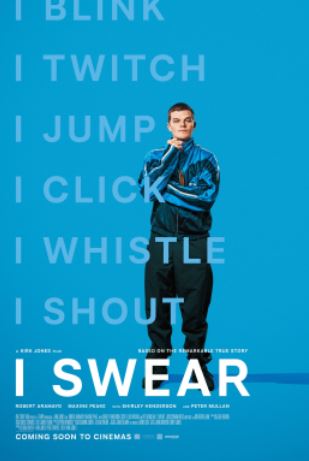
It is also the position of the movie that despite the wreckage to his otherwise healthy life, what Davidson suffers from is — at times — funny. It’s not what he is saying; it’s the delivery of those words. Davidson told the BBC in 2025 that “some of the situations can be really, really funny.” In fact, he says the humor should be “encouraged” because it’s the “one tool that I carry in my toolbox for getting through life.” Notice the movie’s title refers to the humorous part of John’s problem; it’s a gimmicky title that doesn’t really encompass the big picture. In the movie, John’s life is being decimated, but the words come out so instantaneously, there’s a sense of an improv comedic feast in any of his encounters. This is great work by the actor Robert Aramayo, who often conveys John’s disbelief in what he is saying with a quick “For f---’s sake.”
Though Davidson calls humor a “tool,” the movie never suggests that he ever considered a career in comedy. It’s a very tough business. It takes talent plus a very thick skin. Few are capable of it. Uncontrollable statements might be a deal-breaker for a comedy show. Audiences would have to be prepared. Many, perhaps physicians and experts, would recoil at the thought of Davidson putting his condition on display for the sake of laughs.
But the condition is on display for everyone anyway. No question, doing a successful comedy act, in any kind of format, takes all kinds of skill, determination and luck. This is not to say that John Davidson should be doing standup. It’s only worth wondering whether some kind of comedy role might improve his outlook as well as better inform the public about his condition.
The laughs make “I Swear” a first cousin of Jim Carrey’s “Liar Liar” (especially when in court) and Dustin Hoffman’s “Rain Man,” films opposite in tone but united in the concept that things uttered involuntarily can not only move the plot from scene to scene, but do it hilariously. Like Raymond Babbitt, John Davidson will express an obsession with order and alignment, typically called OCD. Is John Davidson on the autism spectrum? Apparently not, though according to the BBC, “Tourette’s rarely appears alone, and the majority of people also have conditions like ADHD, OCD, anxiety or autism. Coprolalia — involuntary swearing — isn’t typical, although it’s often the focus of media attention.”
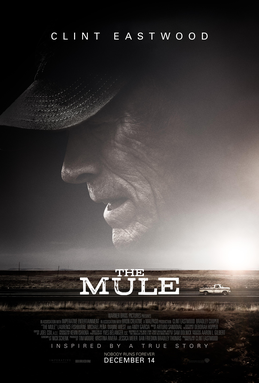
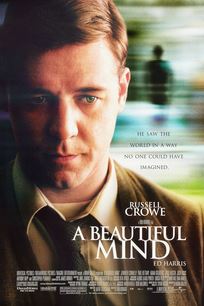
Eventually, “I Swear,” after a brief detour into “The Mule,” will graduate to the more dubious conclusion of Oscar winner “A Beautiful Mind” — that one can overcome a debilitating condition simply by ignoring it and receive one of the world’s highest honors. Unlike in “Rain Man” and “A Beautiful Mind,” John Davidson does not display any extraordinary academic skills (other than, perhaps, how he apparently pours an awesome cup of tea) that could make us think the source of his genius is also the source of his trouble.

There is a fine enough message in “I Swear” of how much our lives can change when someone believes in us. Bigger than that, “I Swear” will deliver one of filmdom’s greatest scenes of the decade, when John enters the back seat of a car to speak with a young woman with a similar affliction. The young woman’s parents have brought her to John because they have heard about him and don’t know where else to turn. John notices her shouting in the back of the car and immediately instructs the parents, “OK, open up.” He will ask her, “You all right pal?,” and she laughs. Rather heartbreakingly, he admits to her, “I just wonder what I did to deserve to be like this.” He is not going to cure her. Her victory, and his, is, You are not alone.
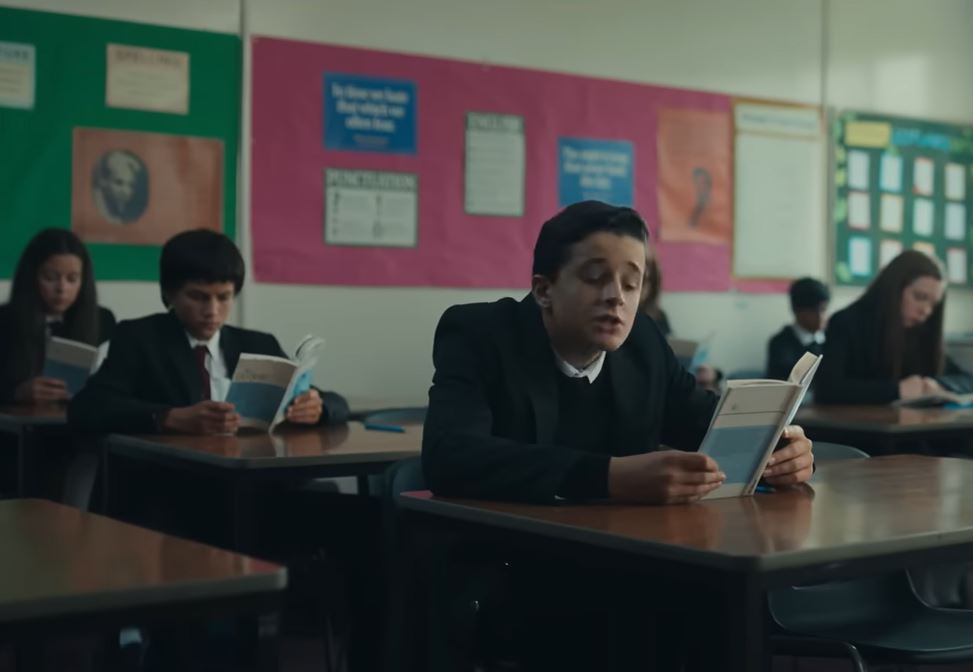
That scene will transition John’s journey from a constant march of one step forward, one step back, to full speed ahead. As the young John, Scott Ellis Watson is up to Aramayo’s level, though generally deprived of the comedy. Most films with a younger actor in flashback limit those scenes to a minimum of stage setters. Watson’s role, which lasts about 24 minutes of screen time, involves a significant amount of drama and, despite his success, it is nearly too much, as Jones risks dividing the movie between the two actors.
The film does an adequate, but not perfect, job of depicting what must be the exhaustion from Tourette’s. John is often seen in track suits. Unfortunately, Jones leans toward telling us this detail rather than trying harder to show it. True, we often see Davidson making a face, but his conversation will continue without other tics. It’s the sum of the parts, all of that motion of the body, that has to be draining — and imagine what it’s like trying to contain it when around other people. It is this conversation between John and the young woman that is used to get the point across.
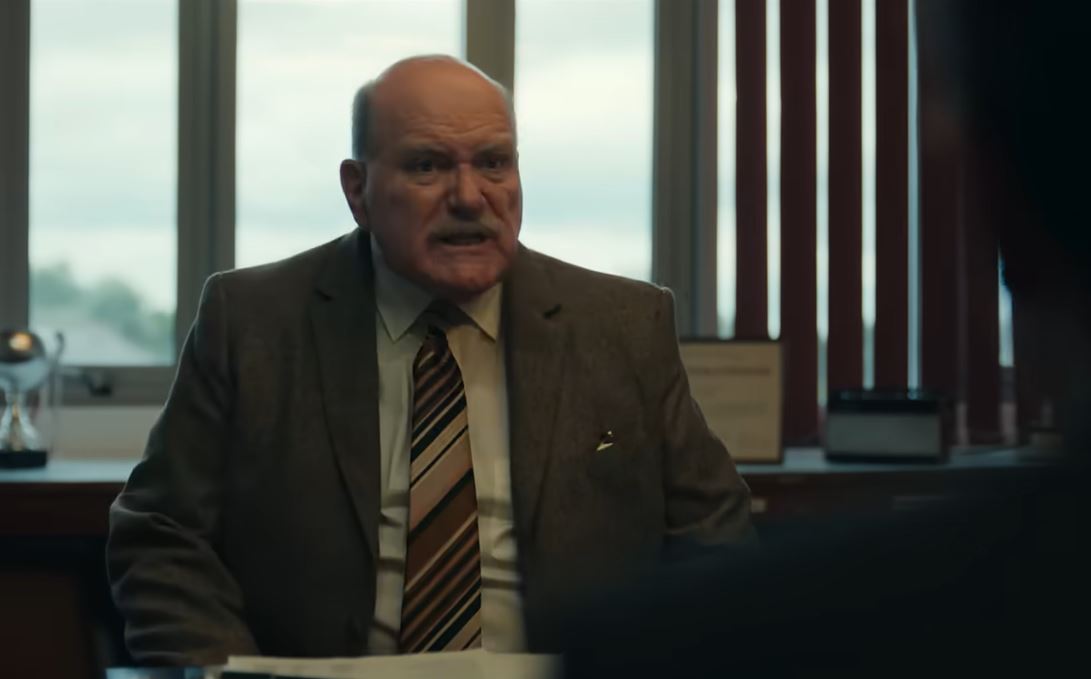
Roger Ebert, in his review of “The Secret of My Success,” which is actually a much better movie than Roger realizes, refers to the “Idiot Plot,” meaning, “Everyone in the movie is an idiot or the mystery would be solved in five minutes.” There is clearly some of that in “I Swear,” in the early scenes, when John’s tics emerge from nowhere, yet neither parents nor school officials bother to consult a doctor or therapist. That is a major contrast with “Rain Man,” in which Charlie will take Raymond to a Texas doctor during their drive. It takes 90 minutes of “I Swear” before anyone reads a book on Tourette’s. In his review of “I Swear,” Mick LaSalle complains, “the clueless behavior of the adults in his life is mind-boggling.” Certainly true. However, by reaching for this absurdity, “I Swear” does make a very strong point: That many of us, perhaps all of us, have conditions that socially affect otherwise healthy people that other people will never understand. A judge will bluntly announce that an expert has deemed that Tourette’s “is not a recognized condition.” From parents to the court system, it’s a world of Blame The Victim.
Where to begin, and end, a movie are big decisions for filmmakers. Jones opts to begin with John’s audience with the Queen, then present nearly all the rest of the film as an extended flashback. Is Jones giving away an outcome that should be earned? One thing this scene tells us is not to believe the “six months” story we’re going to hear later involving a key backer of John. An argument for the opening, as is, would be that viewers in Britain already know of Davidson’s story, so why not lead with the mountaintop, but Jones decides to set up this event as a possible disaster because of one of John’s outbursts, hinting that perhaps he blew it. Even if you had no idea how the ceremony went, you’d have to think, “It probably was fine.”
“I Swear” suggests Davidson was an unknown until middle age, but in fact he had been a British documentary subject since age 16. “John’s Not Mad” aired in 1989. Interest was high enough to spur follow-ups, though the original, according to the Wikipedia page, “has been seen as some sort of comedy classic.”
The saddest depictions of “I Swear” are of John’s interactions with women. He takes a girl to see “Tootsie,” but her mother is skeptical, and while mother is wrong about the reason for being skeptical, her suspicions are confirmed by John’s eruption. John will also experience a bit of a high from being weaned off of medication and announce he’s going to go “clubbin’,” but after impressing some women, he can’t avoid whacking a bystander and ending up in a fight.
Which points to the movie’s problem with values. John’s are a little warped. We see him trading swings in a bar and also agreeing to deliver some kind of contraband. Ideally, we’d like to see John refraining from fighting someone in a bar who had reason to think John was messing with him, and we’d like to hear John say he’s not going to break the law to get more furniture for his apartment. The movie is telling us that John is impulsive and perhaps depressed and sees no way of getting ahead.
The ending credits, featuring images of the real John Davidson, convey that he doesn’t have a significant other but lives with his dog. Is he too tough to live with? Or simply prefers bachelorhood?
Artistic license is accepted in any film, but those about real people are held to fairly high standards. For example, Jones could not get away with ending “I Swear” with John Davidson as cured of Tourette’s and enjoying life as a Tech Bro. But sometimes a film can be too tethered to the truth. With the facts as presented, it’s fair to wonder whether this person’s story really should be a feature film, aren’t there other people with difficult conditions who get up every day and try to make a difference?
Much of John’s dialogue involves apologizing, and there is an issue here for Aramayo, Jones and Davidson. Certainly for John, but for the viewer as well, the apologies tend to get tedious. Throughout the film, they tend to sound routine. The routine nature of the apology might rightly make a “victim” of one of John’s outbursts think they’re being put on. There is no discussion in the film with any expert, or even a layman, as to how to improve this conveyance for the sake of everyone. John will find a champion, Dottie, in the same way a lot of movie characters impress someone — bluntly telling her something. But Dottie is not particularly helpful in the optics department, telling John that there’s a rule in the house that no one apologizes for something that’s not their fault.
Unlike in “A Beautiful Mind,” John is not going to win a Nobel. His accomplishment is not research, but advocacy. There’s a stark absence of any kind of medical interest in this problem throughout the film. John does not take any experimental medication. As a young man, when meeting Dottie, he admits he’s on haloperidol. Dottie’s skepticism informs us on the merits of this drug. “I don’t think you are OK,” she says. Only at the very end does he take part in an academic study, which appears to be promising.
How do some medical conditions elicit greater academic interest than others? Frequency among the general public would be a high factor, as would the mortality rate. Sometimes, it’s personal experience — Michael J. Fox is vigorously seeking cures and treatments for Parkinson’s. Researchers may find their calling in diseases that have plagued multiple family members. Another important factor is the part of the body involved — Tourette’s would seem to be about brain wiring, and the brain is a very difficult subject.
“I Swear” was released in Britain in 2025 and received five BAFTA nominations. Aramayo was an upset winner for Best Actor, and Lauren Evans won for Casting. Peter Mullan was nominated for Best Supporting Actor, as was Jones for Best Original Screenplay. It was also nominated for Outstanding British Film, losing to “Hamnet.” Many of the awards went to “One Battle After Another.”
The BAFTA ceremony provides fodder for those who may be inclined to agree with some of the less-enlightened folks in “I Swear” that the outbursts attributed to Tourette’s may not be so uncontrollable or unplanned. Around the time of the release of “I Swear” in America, the whole world — literally, pretty much the whole world — was rooting for Celine Dion. She has a very unusual illness too. They happen.
3 stars
(September 2026)
“I Swear” (2025)
Cast:
Robert Aramayo as
John Davidson ♦
Maxine Peake as
Dottie Achenbach ♦
Somerled Campbell as
Palace Official ♦
Michael Dylan as
Butler ♦
David Carlyle as
Chris Achenbach ♦
Christina Ashford as
Queen Elizabeth II ♦
Scott Ellis Watson as
Young John Davidson ♦
Sanjeev Kohli as
Kenny ♦
Steven Cree as
David Davidson ♦
Ethan Stewart as
William (10) ♦
Isla Mercer as
Caroline (7) ♦
Catriona McArthur as
Sharon (13) ♦
Shirley Henderson as
Heather Davidson ♦
Paul Donnelly as
Billie Dean/Attacker Under Bridge ♦
Ron Donachie as
Headmaster Donald Watkins ♦
Jamie McAllister as
Young Murray (12) ♦
Abigail Noon as
Kerry (12) ♦
Ella Victoria Robb as
English Teacher ♦
Sam Felderhof as
Boy 1 ♦
Isaac Chan Adams as
Boy 2 ♦
Leah MacRae as
Mrs. Robinson ♦
Taqi Nazeer as
Gerry ♦
Liam Campbell as
Fight Boy ♦
Douglas Rankine as
Doctor Colin Hargreaves ♦
Francesco Piacentini-Smith as
Murray ♦
Anna-Jorge Somerville as
Dawn ♦
Connor Parkin as
Roddy ♦
Holly Howden Gilchrist as
Suzy ♦
Calum Cormack as
Bouncer ♦
Amber Sylvia Edwards as
Marie ♦
Chris Dixon as
James ♦
John McLarnon as
Police Officer ♦
Jamie Marie Leary as
Irene ♦
Peter Mullan as
Tommy Trotter ♦
Ellie MacDowall as
Girl in Newsagent ♦
Anthony Capaldi as
Andy ♦
David Gallacher as
Sheriff ♦
Thierry Mabonga as
Defence Agent ♦
Gary French as
Procurator Fiscal ♦
Ross Mann as
Journalist 1 ♦
Johnny Austin as
Journalist 2 ♦
Michael Cooke as
Journalist 3 ♦
Donald Morrison as
Priest ♦
Ruth Milne as
Karen ♦
Paddy Towers as
Lad 1 ♦
Cerys Tinney as
Girl ♦
Gregor Mackay as
Danny ♦
Adam McNamara as
PC/Inspector MacCullen ♦
Gordon Peaston as
Councillor Spalding ♦
Paul Cassidy as
Allan ♦
Karen Bartke as
Claire ♦
Andrea Bisset as
Lucy ♦
Christina Modestou as
Alison ♦
Gregory Storey as
Greg ♦
Paul Stevenson as
Paul ♦
Gordon Morris as
Queen’s Speaker ♦
Louise Stewart as
Caroline (34) ♦
Carolina Valdés as
Barbara ♦
Emma Hartley-Miller as
Woman on Train
Directed by: Kirk Jones
Written by: Kirk Jones
Producer: Kirk Jones
Producer: Georgia Bayliff
Producer: Piers Tempest
Executive producer: John Davidson
Executive producer: Cindy Jones
Co-producer: Lauren Cox
Line producer: Graeme Mackenzie
Music: Stephen Rennicks
Cinematographer: James Blann
Editor: Sam Sneade
Casting: Lauren Evans
Production design: Sabrina Linder
Art direction: David Konix
Set decoration: Felicity Good
Costumes: Denise Coombes
Makeup and hair: Raymond McArthur, Deb Kenton, Caroline Hamilton, Claire McAndrew, Gemma Ross
Production manager: Kate Eldridge
Stunts: Carter Ferguson, Paul Donnelly