


How did Marilyn Monroe die?
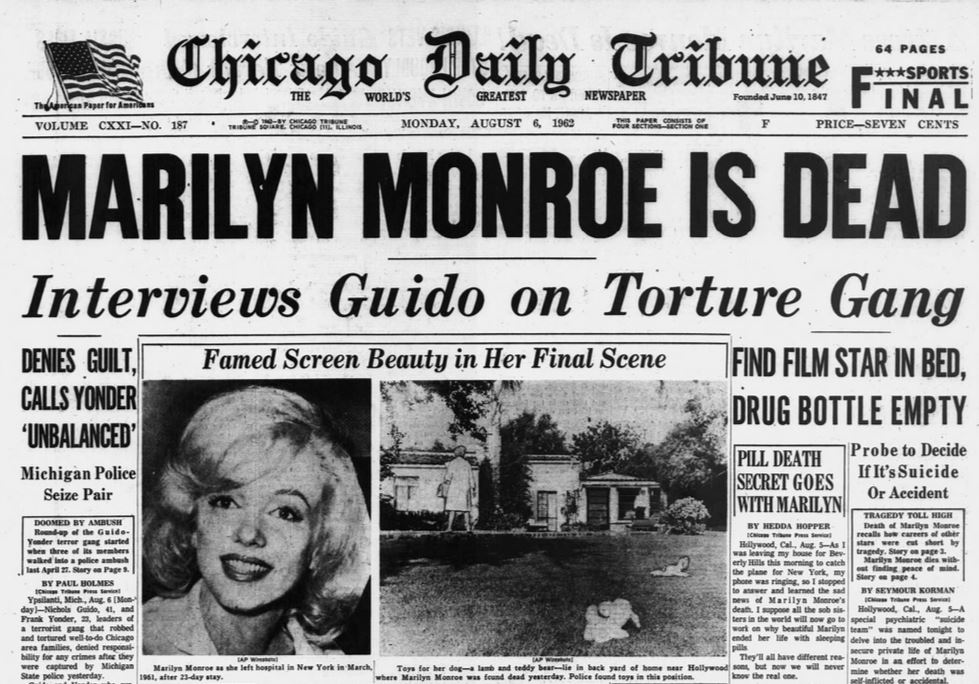
Marilyn Monroe, Hollywood superstar, 36, was found dead in her bedroom at her home in Brentwood on Aug. 5, 1962.
The home, according to the New York Times of Aug. 6, 1962, was a one-story stucco house at 12305 Fifth Helena Drive.
The New York Times of Aug. 6, 1962, reported, “Hardly any of her neighbors had seen her more than once or twice in the six months since she had moved into her two-bedroom bungalow, which is modest by Hollywood standards.”
The Chicago Tribune reported on Aug. 6, 1962, that Monroe’s body was found by her psychiatrist, Dr. Ralph Greenson, who “broke into the bedroom after he was summoned by her alarmed housekeeper, Mrs. Eunice Murray. Ten hours before, Marilyn had telephoned Dr. Greenson and complained she could not sleep, and he had told her to take an automobile ride,” which she apparently did not do.
The New York Times reported on Aug. 6, 1962, that “Beside the bed was an empty bottle that had contained sleeping pills. Fourteen other bottles of medicines and tables were on the night stand.”
The Chicago Tribune reported that the bottle had previously held 50 nembutal capsules.
The Chicago Tribune reported, “According to Mrs. Murray, the housekeeper, Marilyn telephoned Dr. Greenson at 5:15 o’clock last evening and told him she was unable to sleep. Dr. Greenson later confirmed this and said that he told Marilyn to take an automobile ride to the beach. Mrs. Murray said Marilyn didn’t go for a ride, and retired about 8 p.m. Death is believe to have occurred soon after.”
The New York Times described Greenson as a “psychoanalyst.”
The New York Times reported that “Mrs. Murray told the police that Miss Monroe retired to her bedroom about 8 P.M. yesterday. About 3:25 A.M. today, the housekeeper noticed a light under Miss Monroe’s door. She called to the actress, but received no answer. She tried the bedroom door. It was locked. Mrs. Murray went outside and peered into the bedroom through the closed French windows. Miss Monroe, she later told the police, looked ‘peculiar.’ An arm was stretched across the bed and a hand hung limp on a telephone, she said. The housekeeper rushed back into the house and telephoned Miss Monroe’s analyst, Dr. Ralph R. Greenson. When he arrived a short time later, he broke a pane of the French window and opened it. He quickly examined the star. She was dead. He phoned Miss Monroe’s personal physician, Dr. Hyman Engelberg. After his arrival, the police were called. This was at 4:20, almost an hour after the housekeeper had called Dr. Greenson.”
The Chicago Tribune reported on Aug. 6, 1962, that “Dr. Greenson said he removed the actress’ hand from the telephone; he didn’t recall which hand.”
The Chicago Tribune of Aug. 6, 1962, reported that Coroner Theodore J. Curphey “listed the case as ‘suicide’ but followed that word by a question mark on his records. Police were more inclined to consider the death as accidental, particularly, they said, because there were no suicide notes found.” After the autopsy, Curphey said, “The death was not a natural one and we can make a presumptive opinion that it was due to an overdose of a drug.”
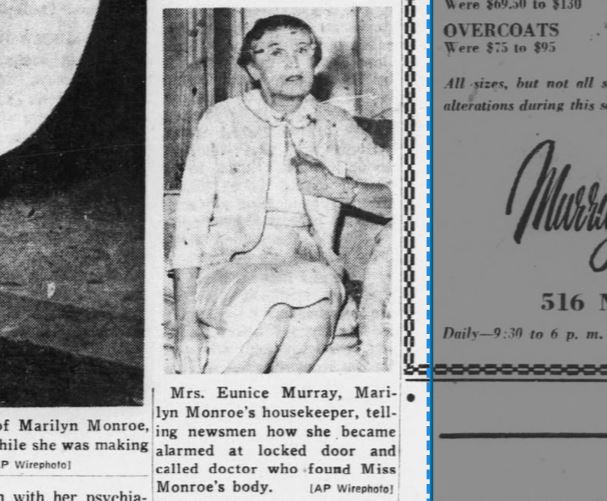
The Chicago Tribune of Aug. 7, 1962, reported Mrs. Murray’s account of Monroe’s final days, saying Monroe went out for dinner Friday evening with friend and publicist Patricia “Pat” Newcomb, who was also at the house Saturday and was Marilyn’s last guest; she “left about 6 o’clock in the evening. Marilyn seemed in very good spirits when Pat left.”
Mrs. Murray said: “The last words Marilyn said to me were: ‘I think we’ll not go to the beach tomorrow for a ride.’ Then she closed the door and retired for the night.”
The Tribune on Aug. 7 also reported that neighbor Jeanne Carmen “saw Marilyn two weeks ago and remarked of her: ‘She looks like death.’ ”
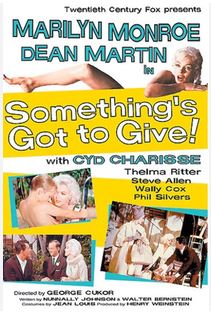
According to the New York Times of Aug. 6, 1962, “In 1961, she was twice admitted to hospitals in New York for psychiatric obersvation and rest. She was dismissed in June by Twentieth Century-Fox after being absent all but five days during seven weeks of shooting ‘Something’s Got to Give.’ ...
Mrs. Murray said, according to the Aug. 7, 1962, Chicago Tribune, “That firing was hard for her to take. She was ill during this period.”
“In her last interview, published in the Aug. 3 issue of Life magazine, she told Richard Meryman, an associate editor: ‘I was never used to being happy, so that wasn’t something I ever took for granted.’ ”
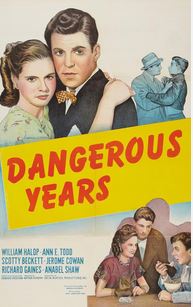
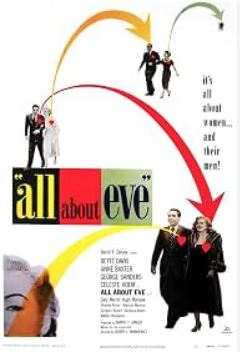
The New York Times of Aug. 6, 1962, claims “The Asphalt Jungle” was Monroe’s “first picture.” However, credits at the Internet Movie Database indicate 1947’s “Dangerous Years” was her first film and that “The Asphalt Jungle” was her fourth credited film, among some early uncredited roles.
In the wake of her death, the New York Times reported that Monroe’s third husband, Arthur Miller, was reached in Connecticut and “was asked if he had any comment” and replied, “I don’t, really.”
The New York Times reported that Joe DiMaggio, Monroe’s second husband, was “unavailable for comment.”
The Chicago Tribune reported that Joe DiMaggio “flew in from San Francisco. His sister had heard the news of the actress’ death in a radio bulletin in San Francisco and advised DiMaggio. United Airlines held up a flight for several minutes so he could board it to rush here. DiMaggio went into seclusion tonight in the Miramar hotel in Santa Monic. He said he would have no comment. Marilyn and DiMaggio were divorced in 1954 after a marriage of less than 10 months. They remained friends, had dated again recently, and there had been rumors they might remarry. ... Her first marriage, when she was 16 was to Jim Dougherty, who is now a Los Angeles policeman.”
>
The Chicago Tribune reported on Aug. 6, 1962, that “The telephone switchboard at THE TRIBUNE was deluged with calls yesterday about Marilyn Monroe ... The callers — men and women, young and old — wanted to know: Is it true? How did it happen? Why? Why? Why? Several persons asked, ‘When is the funeral?’ ”
The New York Times of Aug 7, 1962, reported, “There was speculation here that the star would be buried according to Jewish ritual. Miss Monroe became a Jewish convert when she married Arthur Miller, the Pulitzer Prize playwright, in 1956. She divorced him in 1960. There were no indications that she had ever renounced her Jewish conversion.” Arthur Miller, according to a UPI report in the Aug. 7, 1962, New York Times, said he was “dreadfully shocked” by Monroe’s death and had not been in touch with her for “about a year.” He said he did not intend to go to the funeral.
The New York Times reported on Aug. 7 that the Vatican newspaper, L’Osservatore Romano, opined that Monroe was a “victim of a symbolic form of life that had been forced on her by other people.”
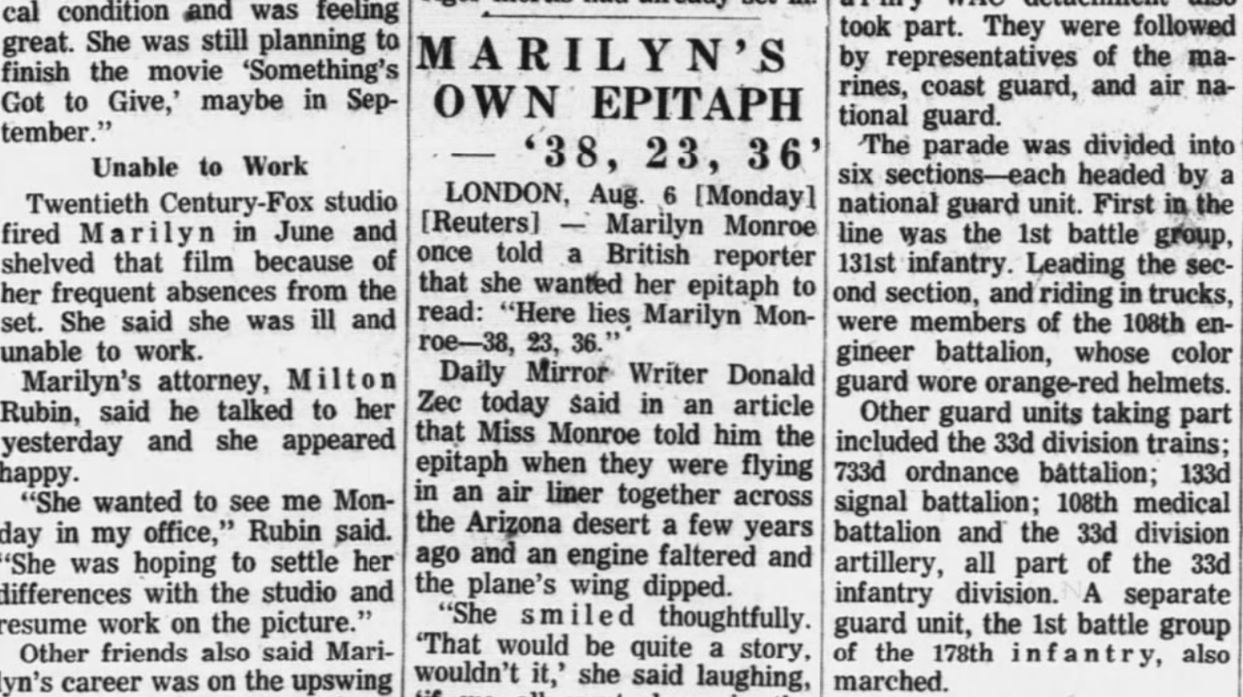
A Reuters story headlined in the Chicago Tribune of Aug. 6, 1962, begins, “Marilyn Monroe once told a British reporter that she wanted her epitaph to read: ‘Here lies Marilyn Monroe — 38, 23, 36.”
The Chicago Tribune reported, “The morgue record listed her as weighing 117 pounds, being 65½ inches tall, and having blonde hair and blue eyes. It was also coldly noted that her skin was blotched — a frequent effect of barbiturate overdosage — and that she was in need of a manicure and pedicure.”
She was born Norma Jean Mortenson on June 1, 1926, in Los Angeles.
(June 2026)