Charles Bronson died at 81 of pneumonia, reportedly battled Alzheimer’s
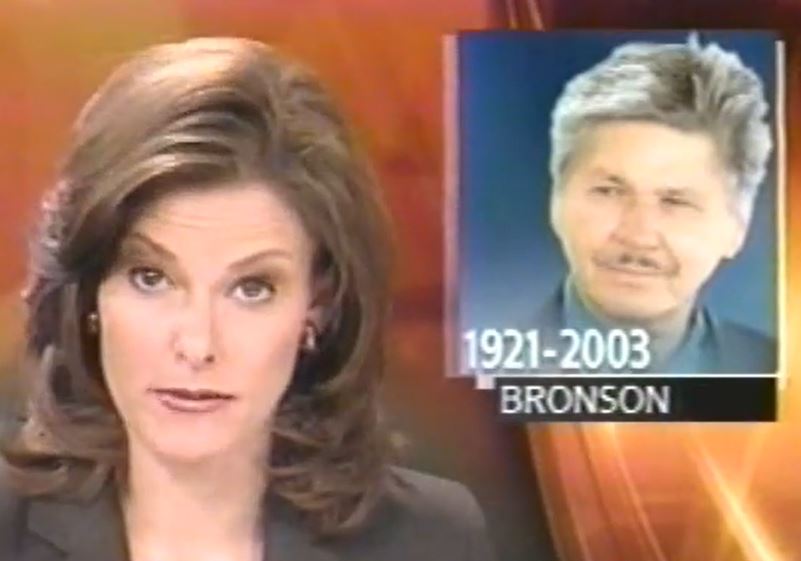
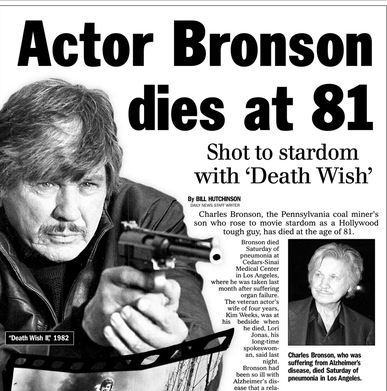
Charles Bronson died at 81 on Saturday, Aug. 30, 2003, at Cedars-Sinai Medical Center in Los Angeles.
According to an Associated Press obituary by Bob Thomas, Bronson died of pneumonia and “reportedly had Alzheimer’s disease.”
An obituary in the Los Angeles Times by Dennis McLellan also stated that Bronson “reportedly” had Alzheimer’s disease.
Citing publicist Lori Jonas, Thomas reported that Bronson’s wife, Kim, was at his bedside, and that Bronson had been hospitalized “for weeks.”
Bronson was married three times, according to the AP and Los Angeles Times obituaries. His first wife was the former Harriet Tendler; his second wife was the actress Jill Ireland, who fought breast cancer for six years and died in 1990 at 54. The L.A. Times reported that Bronson “married his third wife, actress Kim Weeks, in 1998.”
Bronson’s birth name was Charles Buchinsky. He was born Nov. 3, 1921, in Ehrenfeld, Pa., to Lithuanian parents, the 11th of 15 children. Obituaries state he changed his surname in the 1950s to avoid having a Russian-like name.
Bronson’s military record would draw scrutiny from reporters who apparently didn’t quite believe the official story. The Associated Press obituary by Bob Thomas includes the term “reportedly” in its military description: “Drafted in 1943, he served with the Air Force in the Pacific, reportedly as a tail gunner on a B29 (some reporters questioned whether Mr. Bronson had exaggerated his service).”
In its obituary published Sept. 1, 2003, The New York Times reported, “In 1943, he was drafted into the Army. Years later, after he established himself as an actor, his press releases would say he had been a tail gunner during World War II. But one reporter found that Mr. Bronson was assigned to the 760th Mess Squadron in Kingman, Ariz., and that he drove a delivery truck during the war.”
Weeks later came this note from the Times: “Corrected on Sept. 18, 2003: An obituary of the movie actor Charles Bronson on Sept. 2 and in some late editions on Sept. 1 misstated his military record. Mr. Bronson had indeed been an aircraft gunner during World War II, as his publicity materials said. (His initial assignment, in Kingman, Ariz., involved maintenance and operations of the base messes.) He was a member of the 760th Flexible Gunnery Training Squadron, not the 760th Mess Squadron. In 1945 Mr. Bronson was attached to a B-29 squadron of the 39th Bombardment Group, based in Guam, which conducted combat missions against the Japanese home islands.”
The Los Angeles Times obituary stated, “Drafted into the Army in 1943, he drove a mess truck in Arizona before serving as a B-29 tail gunner in the Pacific.”
Jill Ireland, who appeared in 11 films with Bronson, according to the L.A. Times, died at 54 on Friday, May 18, 1990, at home in Malibu. The Associated Press obituary, citing publicist Lori Jonas, said Ireland was with Bronson “and several of her children.” Ireland had battled breast cancer for six years and received the Medal of Courage from President Ronald Reagan, the obituary stated. The New York Times obituary also mentioned the “Medal of Courage” — it is actually an award of the American Cancer Society and was presented by Reagan on March 29, 1988; the president referred to it as “ the 1988 Cancer Courage Award.”
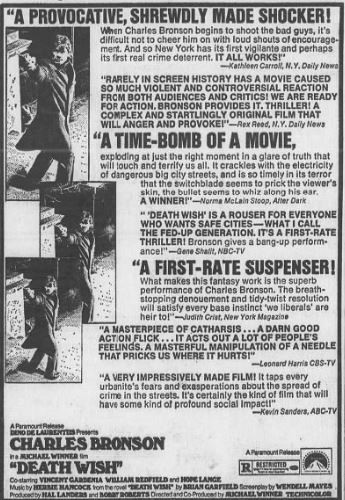
The most famous film attributed specifically to Bronson is certainly “Death Wish” (1974). It is one of the most polarizing roles in the history of film. It is not given the same amount of artistic latitude as “Dirty Harry.” Obituaries in both the New York Times and Los Angeles Times referred to their papers’ critics, Vincent Canby and Charles Champlin, as deeming “Death Wish” a “despicable” film that played on “brute” emotions and bigotry. Yet the L.A. Times obituary stated that “audiences around the country often applauded and cheered whenever Bronson let one of the film’s menacing thugs have it.”
It missed the initial cut by the guardians of film history. According to the Chicago Tribune of Sept. 5, 2003, Turner Classic Movies honored Bronson by showing “The Magnificient Seven,” “The Great Escape,” “The Dirty Dozen” and “From Noon Til Three” on Sept. 13, 2003. “Death Wish” apparently was not aired by TCM until 2025.
Dennis Hearst, the college student who delivered Abigail Folger’s bike at 10050 Cielo Drive on the night of the Sharon Tate murders, actually mentions Bronson in a recent YouTube account. Explaining the clientele at his family’s Beverly Hills bike shop, Hearst recalls “three episodes” with Bronson. “He was a very gruff, kind of a bull-in-the-china-shop kind of guy, and kind of barking orders to people, and frankly being, uh, pretty rude. Maybe that was his persona, maybe that was his real personality.” But Bronson had an assistant who would “unruffle feathers” after Bronson left.
According to a Sept. 7, 2003, article posted by the New York Post, Bronson’s hometown actually declined to put up a sign honoring him in the early 2000s. “They said Charlie didn’t do a damn thing for this town,” the council president said, and the article said Bronson “rarely visited or looked up childhood friends.”
There is no record of President George W. Bush issuing any kind of statement on the death of Charles Bronson.
(October 2026)